Foundation Repair Contractor in Waldorf, MD
Waldorf Foundation Repair addresses foundation cracking, structural settlement, sinking footings, bowing basement walls, and uneven floors for residential and commercial properties throughout Waldorf and surrounding Southern Maryland communities.
Top Rated Foundation Repair Company Near Waldorf
Signs You May Need Foundation Repair in Waldorf, MD
Foundation movement rarely happens overnight. Recognizing subtle early indicators allows property owners in Waldorf to have structural conditions evaluated before localized settling progresses into widespread structural displacement. It is important to note that individual symptoms do not automatically confirm structural failure; a systematic evaluation is necessary to identify underlying causes.
Stair-Step Foundation Cracks
Stepped crack patterns running along mortar joints in concrete block (CMU) or brick foundations, frequently signaling uneven differential foundation settlement beneath footings in Charles County.
Horizontal Foundation Wall Cracks
Horizontal fissures appearing mid-height on basement walls, typically resulting from external hydrostatic pressure and lateral soil expansion pushing against the foundation.
Bowing or Inward Leaning Walls
Concrete or masonry walls curving inward toward the basement interior. Without stabilization, continued lateral pressure can compromise structural load-bearing capacity.
Doors & Windows Sticking
Interior or exterior doors jamming in their frames, windows binding during opening, or diagonal cracks radiating from the upper corners of door jambs due to framing distortion.
Uneven, Sloping, or Bouncy Floors
Flooring that dips toward the center of rooms, creates floor squeaks, or gaps beneath baseboards, often indicating crawl space joist deflection or settled interior support piers.
Gaps Around Window Frames & Doors
Separation between brick veneer and caulking joints around windows or exterior door frames, pointing toward movement in the underlying concrete foundation footing.
Settling Porches & Home Additions
Exterior front porches, patios, or attached home additions pulling away from the main structure, leaving visible gaps along flashing and siding lines.
Sinking or Tilting Chimneys
Heavy masonry chimneys leaning away from rooflines or pulling exterior framing outward, signaling concentrated soil settlement under the specialized chimney footing pad.
Basement Water Seepage & Leaks
Water intrusion pooling along floor-wall cold joints or leaking through foundation cracks, introducing moisture that accelerates structural masonry deterioration.
Noticed One or More of These Symptoms at Your Property?
Scheduling a site evaluation can help determine whether visible cracking represents cosmetic shrinkage or active structural movement.
Foundation Repair Services Near Waldorf, Maryland
Every foundation problem has a specific underlying cause. We offer thirteen core structural service categories engineered to resolve settlement, wall movement, crawl space failure, and moisture intrusion across residential and commercial properties.
Foundation Repair
Comprehensive residential and commercial foundation stabilization engineered for long-term structural integrity.
Foundation Crack Repair
Precise evaluation and structural repair of stair-step, horizontal, vertical, and diagonal foundation wall cracks.
Settlement & Sinking Foundation Repair
Stabilization and structural lifting solutions for foundations experiencing downward soil settlement and displacement.
Bowing Basement Wall Repair
Restoring inward wall movement and counteracting heavy lateral soil pressure with proven structural bracing systems.
Helical Pier Installation
Engineered screw-pile pier systems drilled into stable, load-bearing strata for reliable structural underpinning.
Push Pier Installation
Hydraulically driven steel push pier systems transferring heavy building weight deep into competent bedrock layers.
Foundation Underpinning
Extending, deepening, and reinforcing existing footings to provide reinforced load capacity against soil shifts.
Basement Wall Stabilization & Carbon Fiber
High-tensile carbon fiber grid straps and steel beam reinforcement to permanently arrest foundation wall deflection.
Crawl Space Structural Repair & Support Jacks
Heavy-duty adjustable steel jack posts, joist reinforcement, and subfloor support stabilization beneath your home.
Sagging & Uneven Floor Repair
Addressing interior floor bounce, sloping, and squeaking caused by subfloor movement or compromised load-bearing piers.
Block & Concrete Foundation Repair
Expert masonry repair and structural sealing for poured concrete foundations and concrete cinder block walls.
Basement Foundation Waterproofing
Targeting water intrusion, basement wall seepages, and moisture pressure without neglecting structural conditions.
Commercial Foundation Repair
Structural stabilization, underpinning, and foundation remediation tailored for light-commercial and retail buildings.
Complete Foundation Repair & Structural Stabilization Services Near Waldorf
Waldorf Foundation Repair provides foundation repair, structural stabilization, foundation crack repair, pier installation, underpinning, basement wall reinforcement, crawl-space structural support, and floor stabilization services throughout Waldorf, Charles County, and surrounding Southern Maryland communities. This expanded section is designed to help homeowners understand the purpose of each repair method, the warning signs associated with foundation problems, the benefits of professional structural repairs, and the common situations where each solution may be appropriate.
Foundation Repair Services in Waldorf
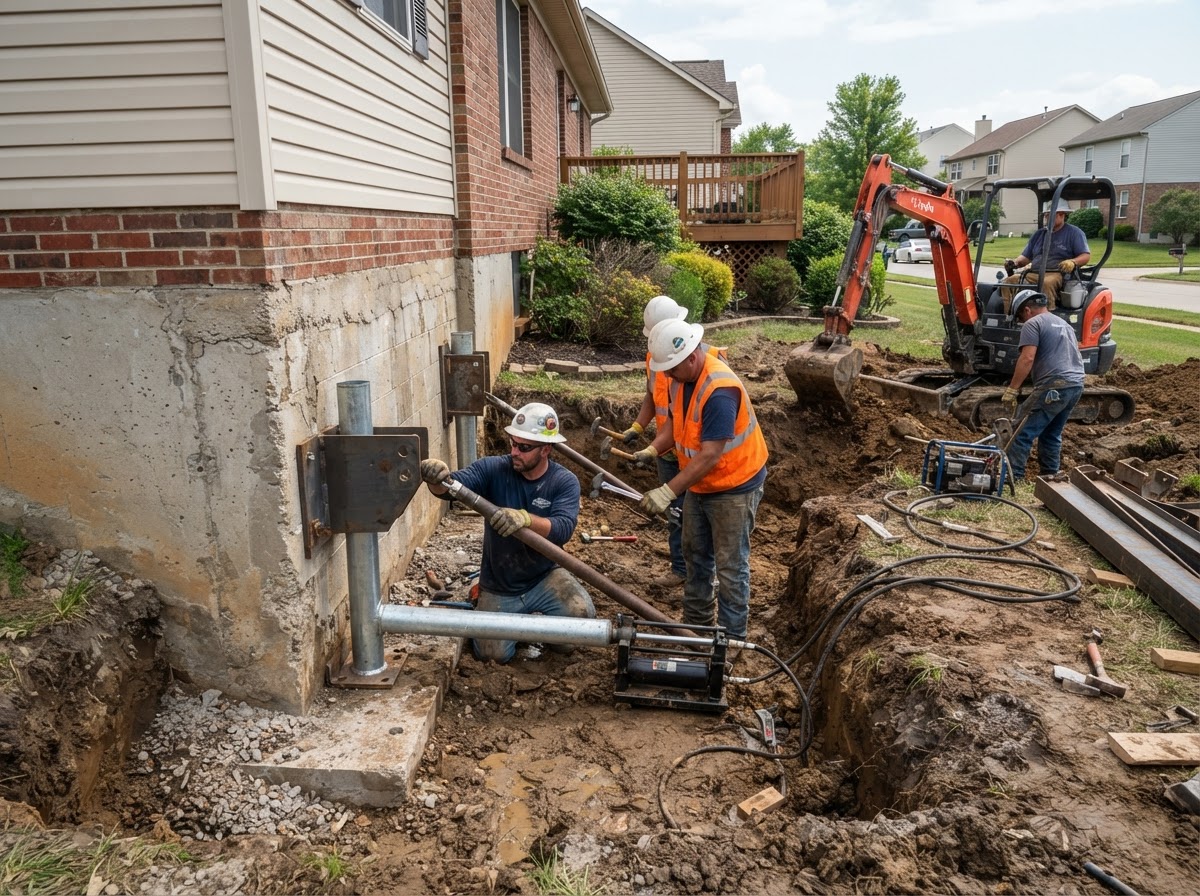
Foundation repair for Waldorf homes addresses structural movement, visible cracking, settlement, and other foundation-related concerns that can develop when the support beneath a home changes. Symptoms such as uneven floors, separating walls, sticking doors and windows, and foundation displacement often warrant evaluation rather than assumption, because the appropriate repair depends on the actual condition of the structure.
Soil-related movement, drainage-related foundation stress, and long-term settlement can each contribute to foundation problems in different ways. A property-specific evaluation helps determine whether stabilization, pier support, crack-related structural repair, or another approach fits the conditions present at the home.
Benefits for Waldorf Property Owners
- Stabilization of compromised foundation areas
- Reduced risk of continued structural movement
- Improved support for the structure above
- Addressing the source of certain foundation symptoms
- Clear repair planning based on property conditions
Repair Features & Project Considerations
- Foundation-condition evaluation
- Crack-pattern review
- Settlement assessment
- Soil and drainage considerations
- Pier or underpinning requirements
- Structural-access considerations
Common Repair Types & Solutions
- Settlement repair
- Foundation stabilization
- Pier-supported repairs
- Underpinning
- Localized foundation repairs
Foundation Crack Repair Near Waldorf
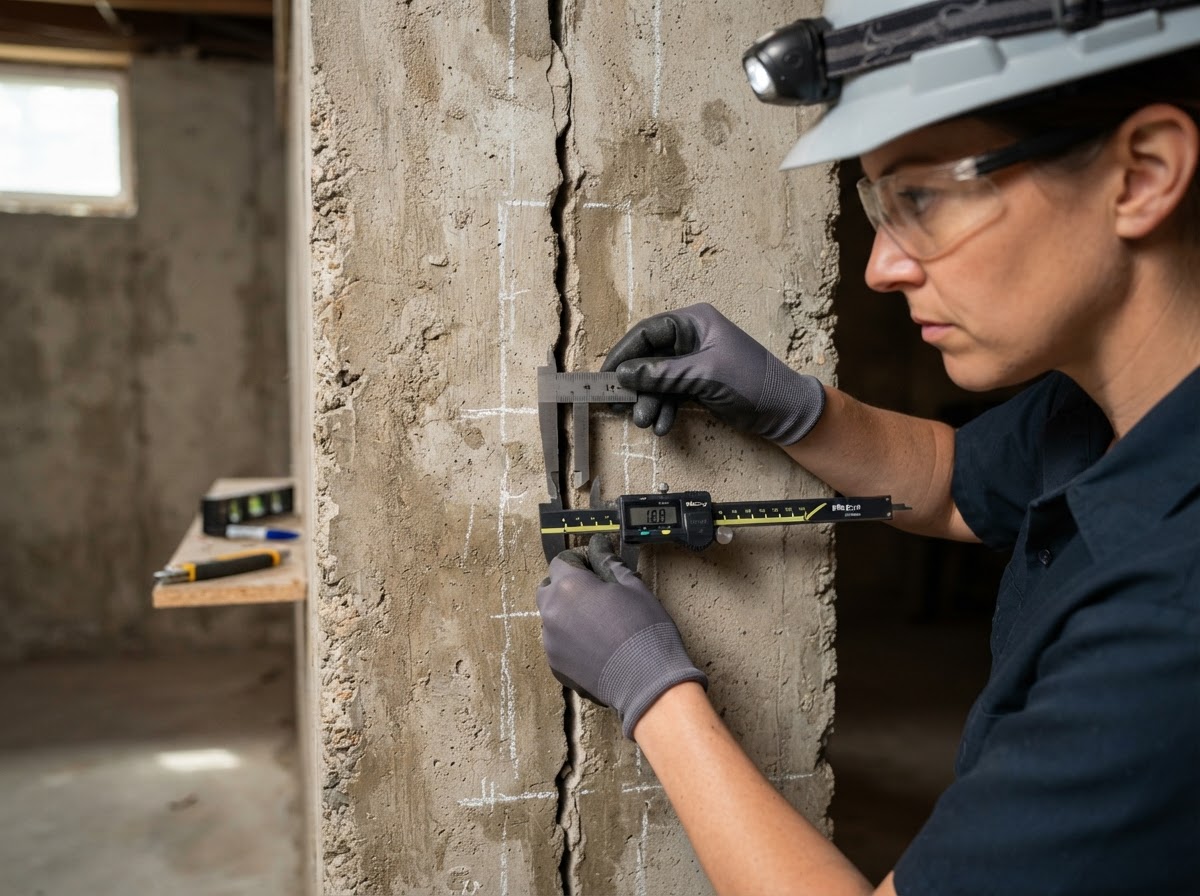
Foundation crack repair near Waldorf covers the evaluation and repair of cracks affecting poured concrete, block, and other residential foundation systems. Vertical foundation cracks, horizontal cracks, stair-step cracking, and shrinkage cracking can each have different causes and structural significance, so crack direction, width, location, and evidence of wall movement all factor into the recommended approach.
Not every crack has the same cause or structural significance. Some cracks reflect minor shrinkage or curing, while others can be associated with moisture intrusion, wall movement, or settlement. Evaluating whether a crack is active or stable helps determine whether repair, reinforcement, or monitoring is appropriate.
Benefits for Waldorf Property Owners
- Sealing appropriate foundation cracks
- Reduced moisture entry through repaired areas
- Identification of potentially structural cracking
- Better understanding of foundation movement
- Prevention of some cracks worsening unnoticed
Repair Features & Project Considerations
- Crack direction and orientation
- Crack width and progression
- Crack location on the wall
- Foundation material (poured or block)
- Moisture conditions around the crack
- Evidence of wall displacement
Common Repair Types & Solutions
- Concrete crack repair
- Block-foundation crack repair
- Structural crack reinforcement
- Crack injection where appropriate
- Related stabilization where movement is present
Foundation Settlement & Sinking Foundation Repair in Waldorf
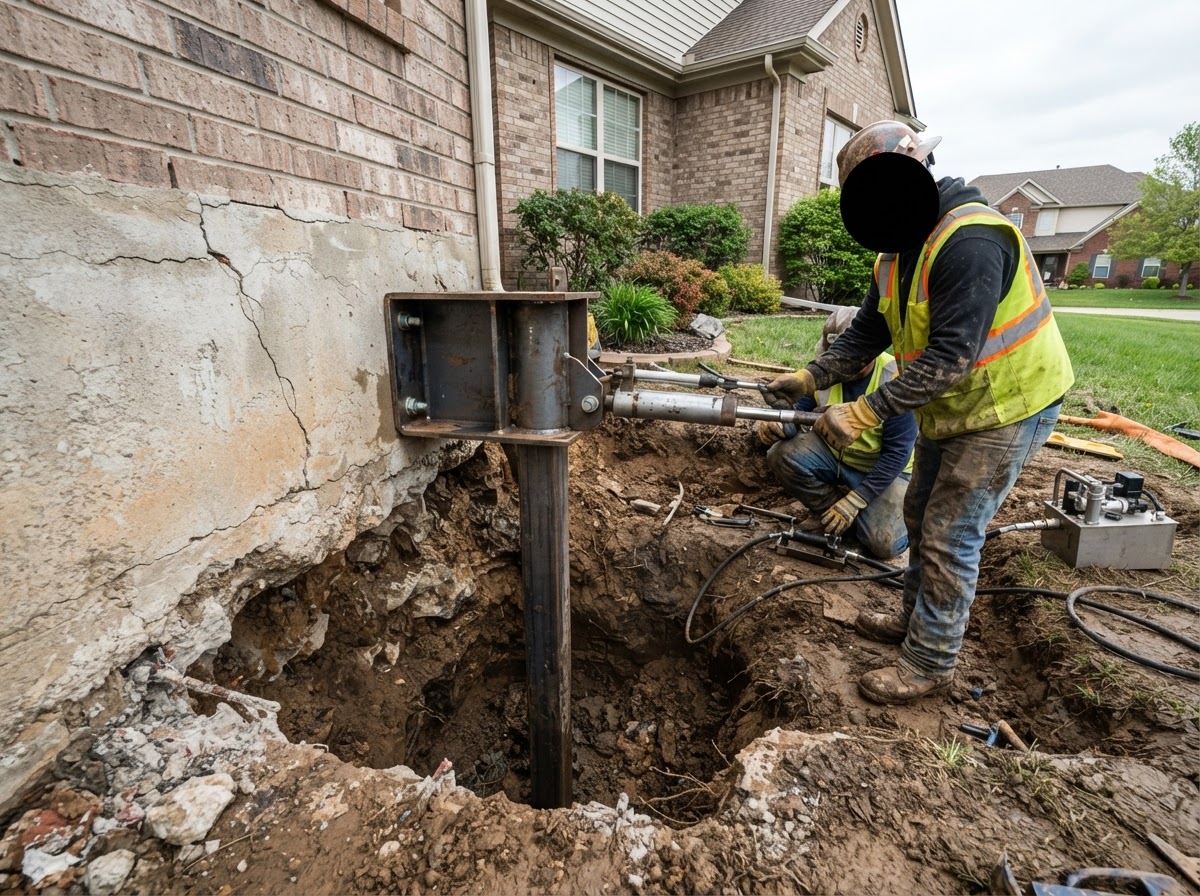
Foundation settlement and sinking-foundation repair addresses homes experiencing downward structural movement. Differential settlement—where one portion of the foundation moves differently than another—can produce foundation elevation differences, cracks associated with settlement, uneven floors, and doors or windows that become difficult to operate.
Contributing conditions can include soil compression, poorly compacted fill, and moisture changes in surrounding soils. Where pier-supported stabilization is appropriate, the objective is typically to stabilize the settling area and reduce continued downward movement rather than to guarantee a return to an exact original elevation.
Benefits for Waldorf Property Owners
- Stabilization of settling foundation areas
- Reduced risk of continued downward movement
- Improved structural support
- Correction planning for settlement-related symptoms
- Long-term support where pier systems are appropriate
Repair Features & Project Considerations
- Settlement pattern evaluation
- Foundation elevation changes
- Soil conditions beneath footings
- Structural loads and distribution
- Pier spacing and placement
- Access for installation
Common Repair Types & Solutions
- Helical pier stabilization
- Push pier stabilization
- Foundation underpinning
- Localized settlement repairs
- Structural support improvements
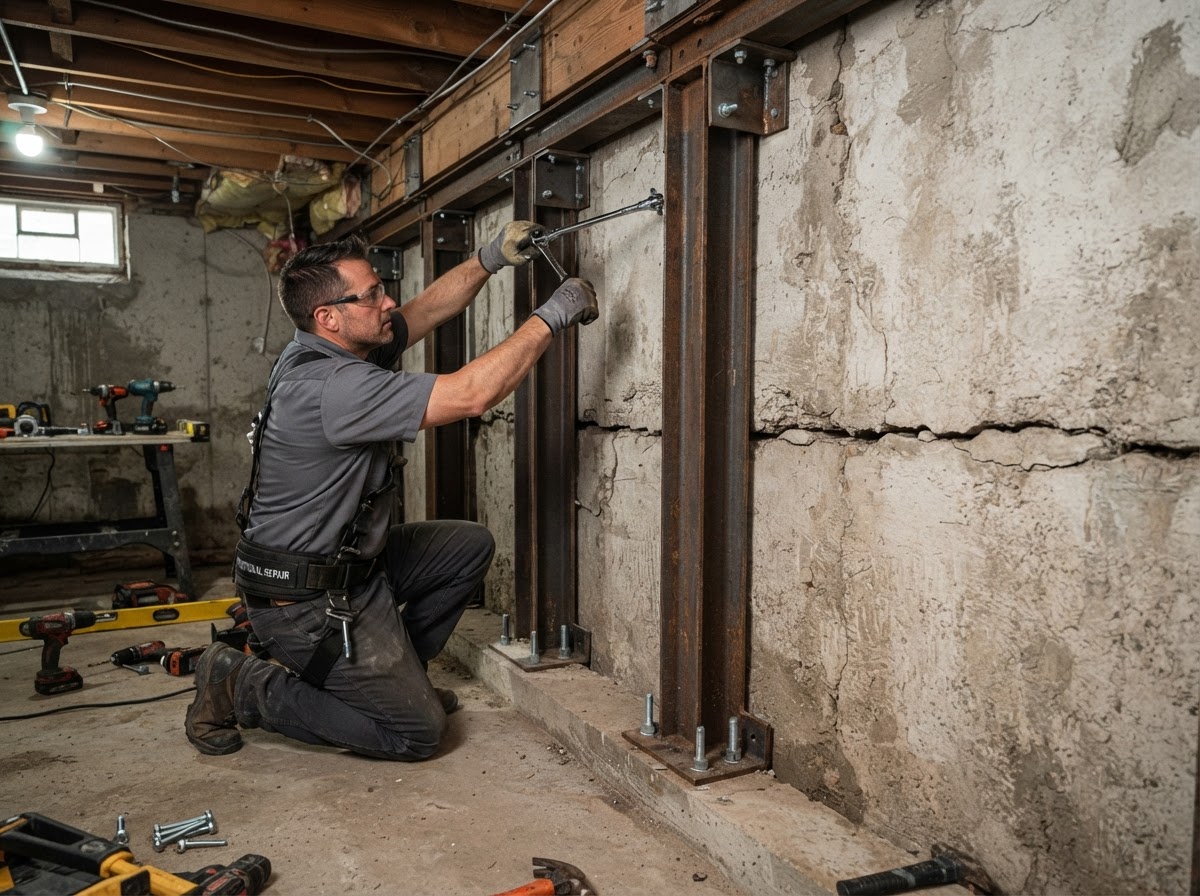
Bowing Basement Wall Repair Near Waldorf
Bowing basement wall repair near Waldorf addresses basement walls showing inward deflection, horizontal cracking, or structural movement. Soil pressure and hydrostatic pressure against below-grade walls can contribute to wall displacement in both block and poured-concrete foundations, and the severity of wall deflection helps determine which reinforcement option fits.
Repair options are tailored to the wall condition rather than applied universally. Evaluating crack orientation, wall material, exterior soil pressure, and drainage conditions helps identify whether carbon-fiber reinforcement, wall-anchor systems, or another stabilization method is appropriate.
Benefits for Waldorf Property Owners
- Stabilization of compromised basement walls
- Reduced risk of continued inward movement
- Improved structural support
- Addressing wall movement before it becomes more severe
- Repair options tailored to wall condition
Repair Features & Project Considerations
- Amount of wall deflection
- Crack orientation (horizontal, stair-step)
- Wall material (block or poured concrete)
- Exterior soil pressure
- Drainage conditions
- Interior access for reinforcement
Common Repair Types & Solutions
- Carbon-fiber reinforcement
- Wall-anchor systems where appropriate
- Structural wall stabilization
- Crack repair combined with reinforcement
- Localized foundation-wall repair
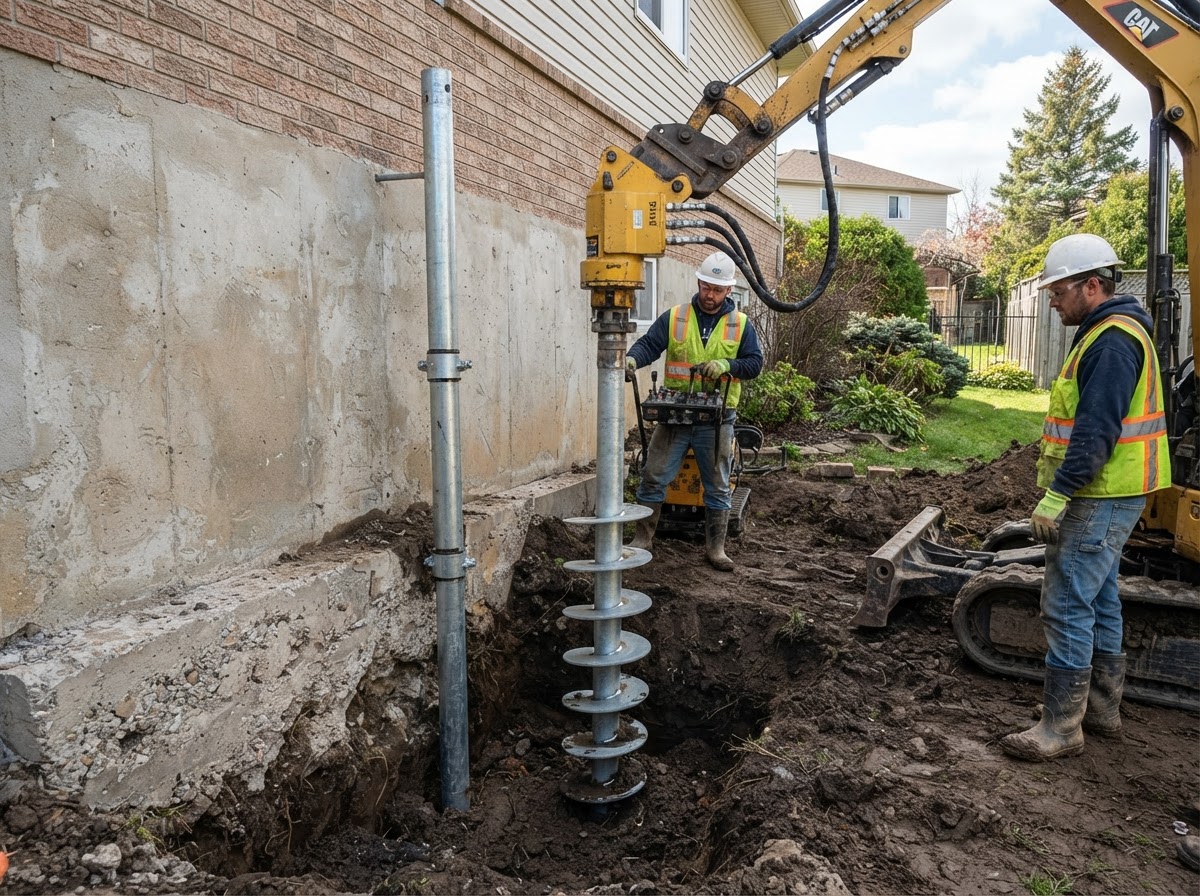
Helical Pier Installation in Waldorf
Helical pier installation in Waldorf uses steel pier systems with helical plates to stabilize foundations affected by settlement or inadequate soil support. The piers are advanced using rotational force into suitable bearing soils, and foundation brackets transfer the structure's load to the more stable material below.
Because helical piers do not depend on the structure's weight for installation, they can be well suited to certain residential structures and lighter-load applications. Pier placement, soil characteristics, and installation access are evaluated for each property rather than assumed.
Benefits for Waldorf Property Owners
- Deep foundation support
- Transfer of structural loads to more stable soil
- Limited excavation compared with some traditional methods
- Foundation stabilization in appropriate conditions
- Versatility for certain residential structures
Repair Features & Project Considerations
- Pier placement and spacing
- Soil characteristics at the site
- Installation torque monitoring
- Foundation load requirements
- Bracket connection to footing
- Equipment access considerations
Common Repair Types & Solutions
- Settlement stabilization
- Foundation underpinning
- Residential helical piers
- Localized foundation support
- Structural pier systems
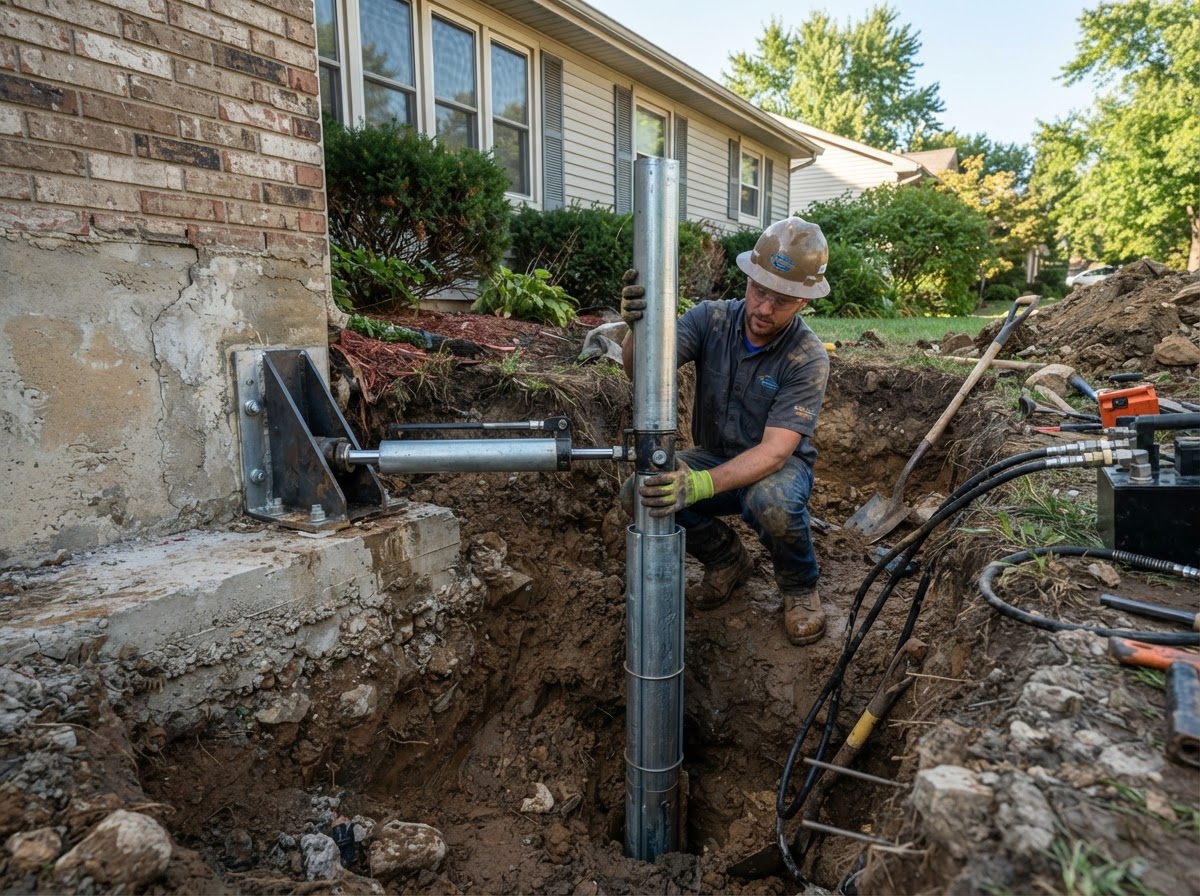
Push Pier Installation Near Waldorf
Push pier installation near Waldorf provides foundation stabilization for suitable structures experiencing settlement. Steel pier sections are hydraulically advanced into load-bearing strata using the existing structural load as resistance, and foundation brackets connect the piers to the footing.
Project-specific suitability depends on the existing structure weight, foundation configuration, and soil profile. Push piers are not used on every settling foundation; the appropriate method is selected based on the conditions present at the property.
Benefits for Waldorf Property Owners
- Deep structural support
- Stabilization of settling foundation sections
- Load transfer to stronger bearing material
- Durable steel foundation-support components
- Targeted repair of settlement areas
Repair Features & Project Considerations
- Existing structure weight
- Pier depth and bearing strata
- Foundation footing condition
- Soil profile beneath the footing
- Bracket installation
- Hydraulic installation requirements
Common Repair Types & Solutions
- Push-pier foundation stabilization
- Sinking-foundation repair
- Foundation underpinning
- Settlement-related pier installation
- Localized structural support
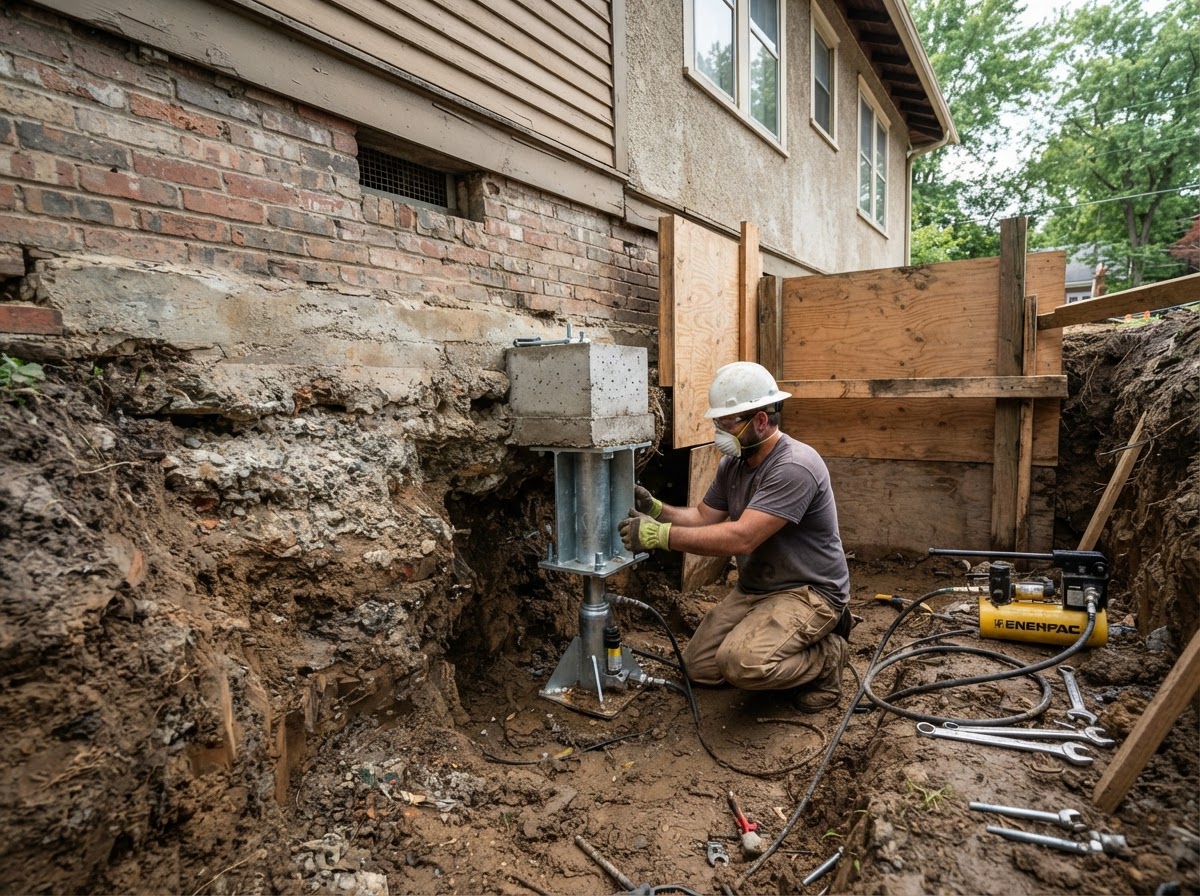
Foundation Underpinning Services in Waldorf
Foundation underpinning services in Waldorf improve support beneath existing foundation areas when existing soils or support conditions are inadequate. Underpinning can involve pier systems that extend support below the existing footing, transferring building loads to more dependable bearing material.
Whether localized or broader underpinning is appropriate depends on the settlement pattern, foundation configuration, structural loads, and soil conditions. Underpinning is related to structural support rather than simply addressing visible cosmetic symptoms.
Benefits for Waldorf Property Owners
- Additional structural support beneath existing foundations
- Reduced risk of continued settlement
- Improved load transfer
- Targeted support for compromised foundation sections
- Compatibility with several pier-based repair strategies
Repair Features & Project Considerations
- Foundation configuration
- Structural loads
- Settlement pattern
- Soil conditions
- Pier type selection
- Installation access
Common Repair Types & Solutions
- Helical-pier underpinning
- Push-pier underpinning
- Localized foundation underpinning
- Settlement stabilization
- Existing-footing reinforcement
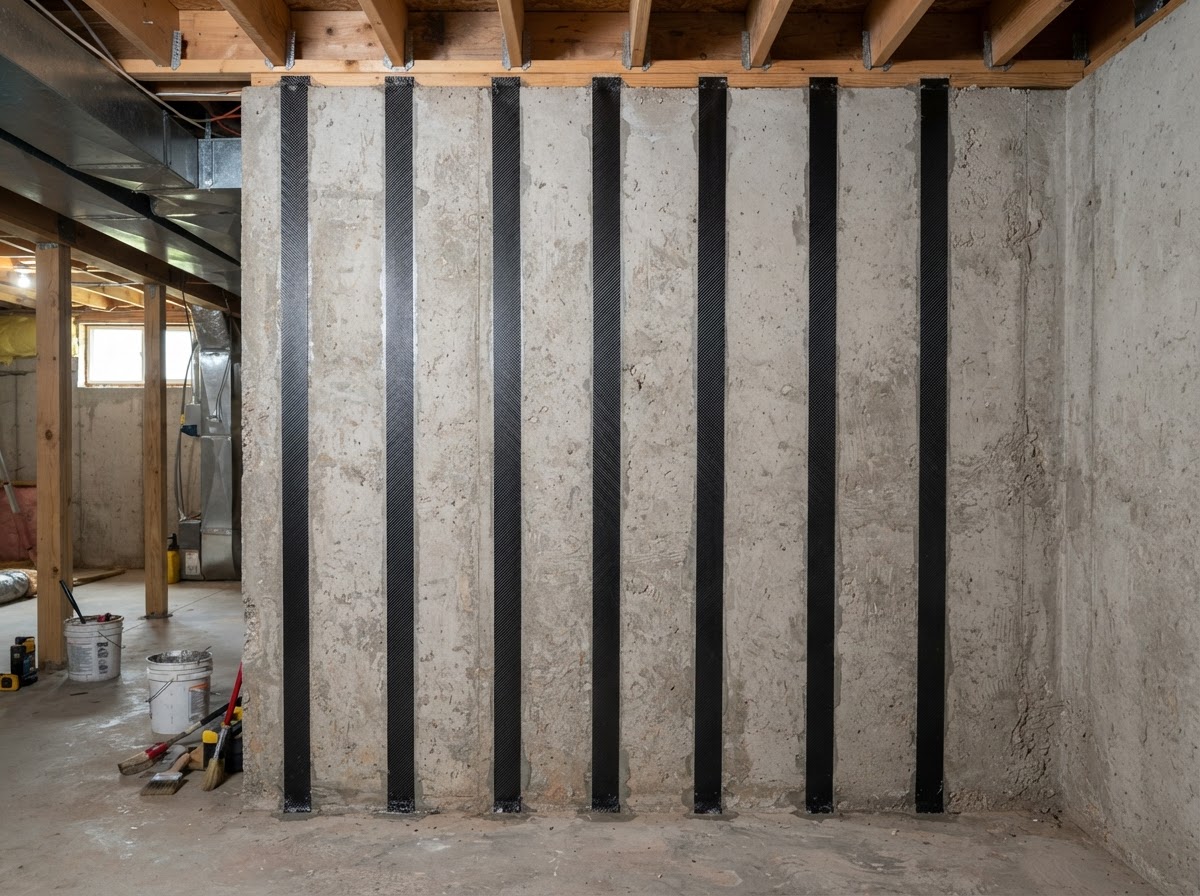
Basement Wall Stabilization & Carbon Fiber Reinforcement Near Waldorf
Basement wall stabilization and carbon-fiber reinforcement near Waldorf addresses inward wall movement and horizontal cracking with low-profile structural reinforcement. Carbon-fiber straps bond to a prepared wall surface to resist further inward deflection where the wall condition is appropriate for that approach.
Carbon fiber is appropriate only for certain wall conditions and is not a universal solution for every level of wall movement. Where deflection is more severe, other stabilization methods may be necessary, so wall deflection, surface preparation, and moisture conditions are evaluated first.
Benefits for Waldorf Property Owners
- Low-profile wall reinforcement
- Strong structural reinforcement material
- Minimal intrusion into basement space
- Stabilization of appropriate wall movement
- Clean finished appearance compared with some larger systems
Repair Features & Project Considerations
- Wall deflection measurement
- Surface preparation requirements
- Crack conditions on the wall
- Bonding substrate condition
- Moisture conditions
- Wall material and structural severity
Common Repair Types & Solutions
- Carbon-fiber wall straps
- Basement-wall reinforcement
- Horizontal-crack reinforcement
- Foundation-wall stabilization
- Combined crack repair and reinforcement
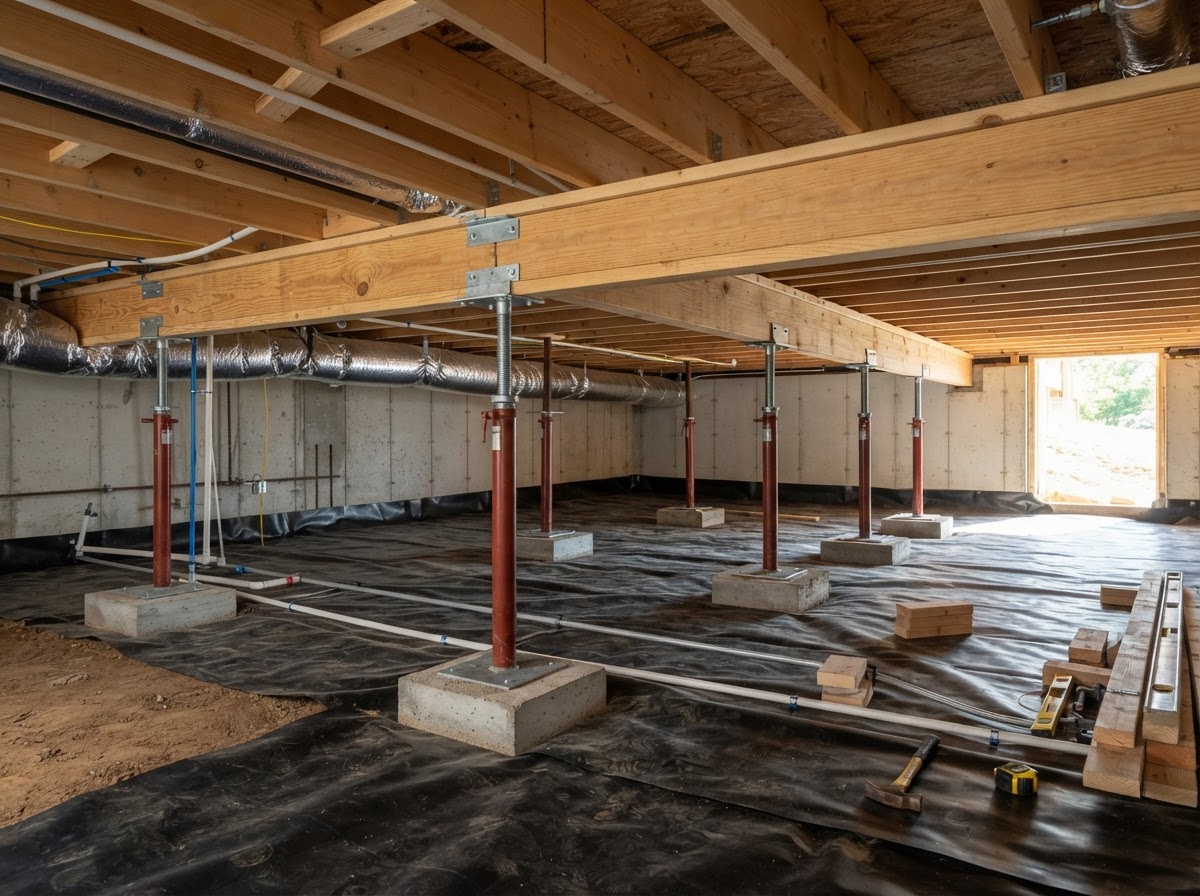
Crawl Space Structural Repair & Support Jacks in Waldorf
Crawl space structural repair and support jacks in Waldorf address floors and framing that have lost adequate support. Sagging floor joists, weak beams, improperly spaced supports, and deteriorated structural wood can all contribute to floor movement that originates beneath the floor system rather than at the perimeter foundation.
Adjustable support jacks and supplemental beams can improve support where appropriate, installed on proper footings rather than improvised temporary posts. Crawl-space height, moisture exposure, and existing framing configuration all factor into the repair approach.
Benefits for Waldorf Property Owners
- Improved support beneath floor systems
- Reduction of excessive floor movement
- Support for weakened beams or joists
- Better distribution of structural loads
- Improved stability in appropriate crawl-space areas
Repair Features & Project Considerations
- Joist condition
- Beam condition
- Support spacing
- Crawl-space height and access
- Moisture exposure
- Footing requirements for supports
Common Repair Types & Solutions
- Adjustable crawl-space support jacks
- Supplemental beams
- Joist reinforcement
- Beam repair
- Floor-system stabilization
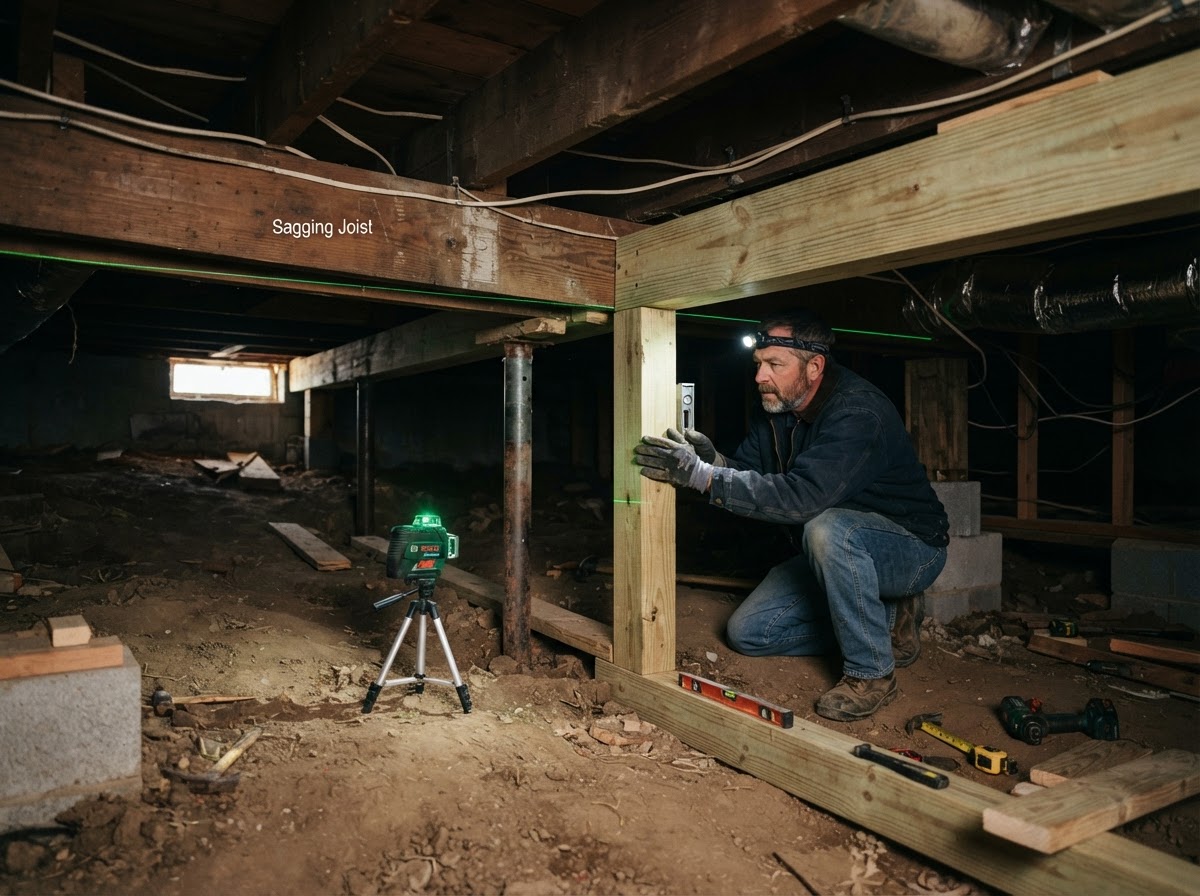
Sagging & Uneven Floor Repair Near Waldorf
Sagging and uneven floor repair near Waldorf addresses floors showing noticeable slope, bounce, dips, or uneven elevations. Flooring symptoms can originate from either the floor framing beneath or the foundation below it, so diagnostic evaluation helps identify whether weak floor joists, beam settlement, crawl-space support problems, or foundation settlement is the underlying cause.
Repair is based on the actual cause rather than a single method. Floor elevation measurements, joist and beam condition, and crawl-space supports are reviewed to determine whether support-jack installation, beam reinforcement, or settlement-related repairs fit the situation.
Benefits for Waldorf Property Owners
- Improved structural support beneath affected floors
- Reduction of excessive floor movement
- Correction planning based on the actual cause
- Reinforcement of compromised structural framing
- Better load support
Repair Features & Project Considerations
- Floor elevation measurements
- Joist condition
- Beam condition
- Crawl-space supports
- Foundation settlement indicators
- Moisture-related deterioration
Common Repair Types & Solutions
- Support-jack installation
- Beam reinforcement
- Joist repair
- Supplemental structural supports
- Settlement-related repairs
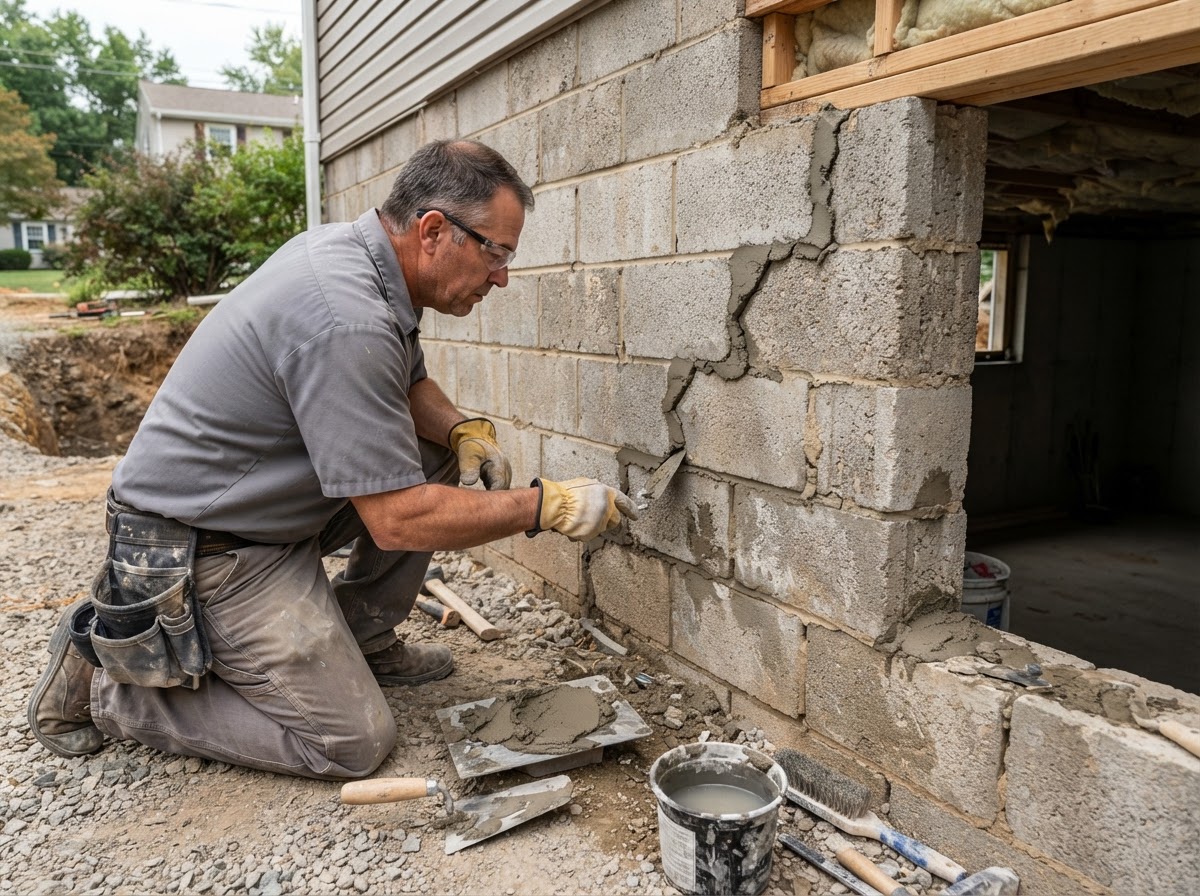
Block & Concrete Foundation Repair in Waldorf
Block and concrete foundation repair in Waldorf addresses the different crack patterns and deterioration forms that affect concrete masonry unit (block) foundations and poured-concrete foundations. Block walls can show stair-step mortar-joint cracks and displaced courses, while poured concrete can develop vertical, diagonal, or shrinkage cracks.
Material-specific repair requirements mean the approach depends on the foundation type, crack pattern, wall displacement, and moisture exposure. Identifying related settlement or pressure concerns helps determine whether reinforcement, mortar-joint repair, or settlement-related structural repair is appropriate.
Benefits for Waldorf Property Owners
- Repairs matched to the foundation material
- Improved structural integrity of damaged areas
- Reduced risk of cracks worsening unnoticed
- Better control of localized wall damage
- Identification of related settlement or pressure concerns
Repair Features & Project Considerations
- Block versus poured-concrete construction
- Mortar-joint condition
- Crack patterns and orientation
- Wall displacement
- Settlement indicators
- Moisture exposure
Common Repair Types & Solutions
- Concrete-foundation crack repair
- Block-foundation repair
- Mortar-joint repair
- Wall reinforcement
- Settlement-related structural repair
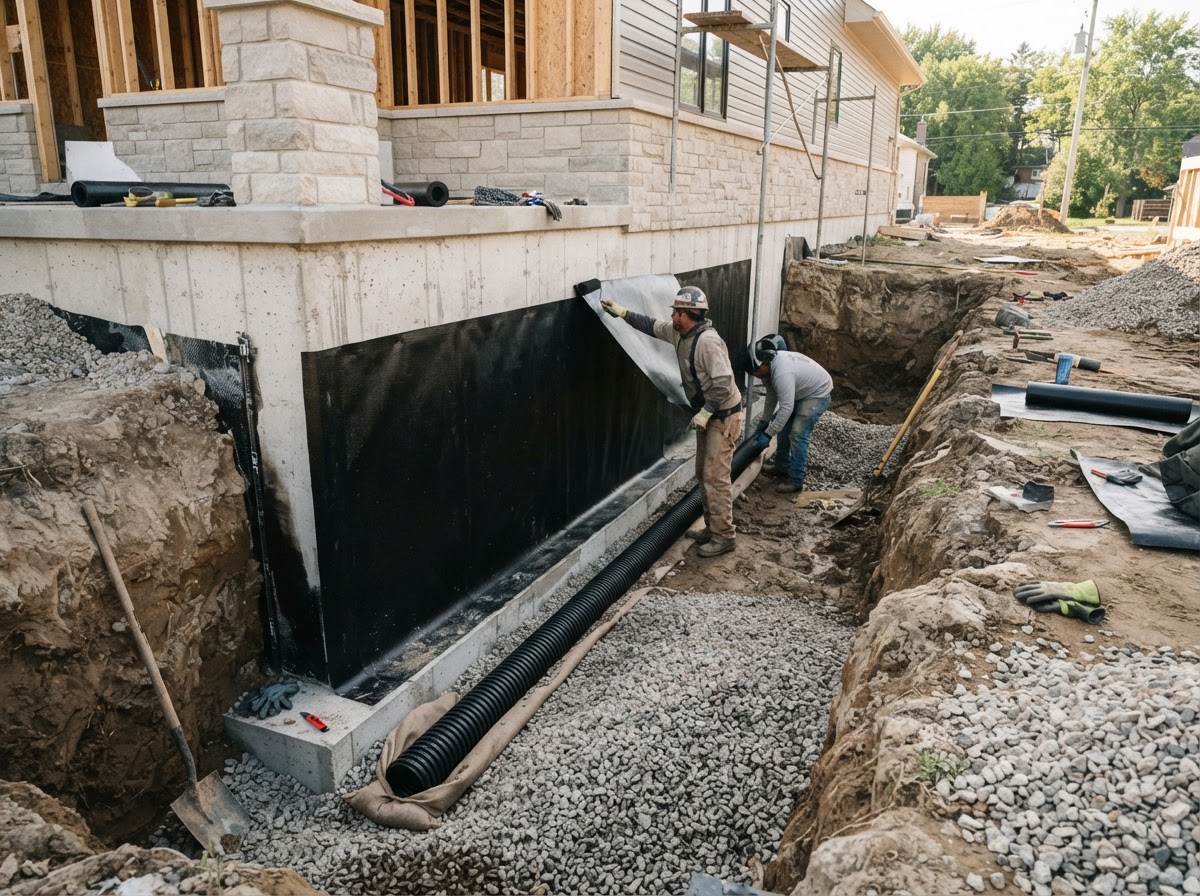
Foundation Waterproofing & Water Management Near Waldorf
Foundation waterproofing and water management near Waldorf addresses how poor drainage and excess water around a foundation can contribute to soil movement, hydrostatic pressure, moisture intrusion, and foundation stress. The focus is foundation-related drainage correction rather than general landscaping work.
Water collecting near the foundation, poor grading, saturated soils, and downspout discharge concerns can all affect foundation-wall conditions. Drainage work manages water but does not by itself correct existing structural movement, so water-management improvements are often coordinated with structural repair where movement is present.
Benefits for Waldorf Property Owners
- Better control of water near foundation areas
- Reduced foundation exposure to saturated soil
- Reduced hydrostatic pressure where appropriate
- Improved protection of foundation-repair areas
- Identification of water-management conditions contributing to foundation stress
Repair Features & Project Considerations
- Property grading
- Water flow paths
- Soil conditions
- Downspout discharge
- Foundation-wall conditions
- Existing structural damage
Common Repair Types & Solutions
- Foundation drainage improvements
- Exterior water-management corrections
- Drainage around foundation-repair areas
- Foundation-adjacent grading recommendations
- Water-routing improvements
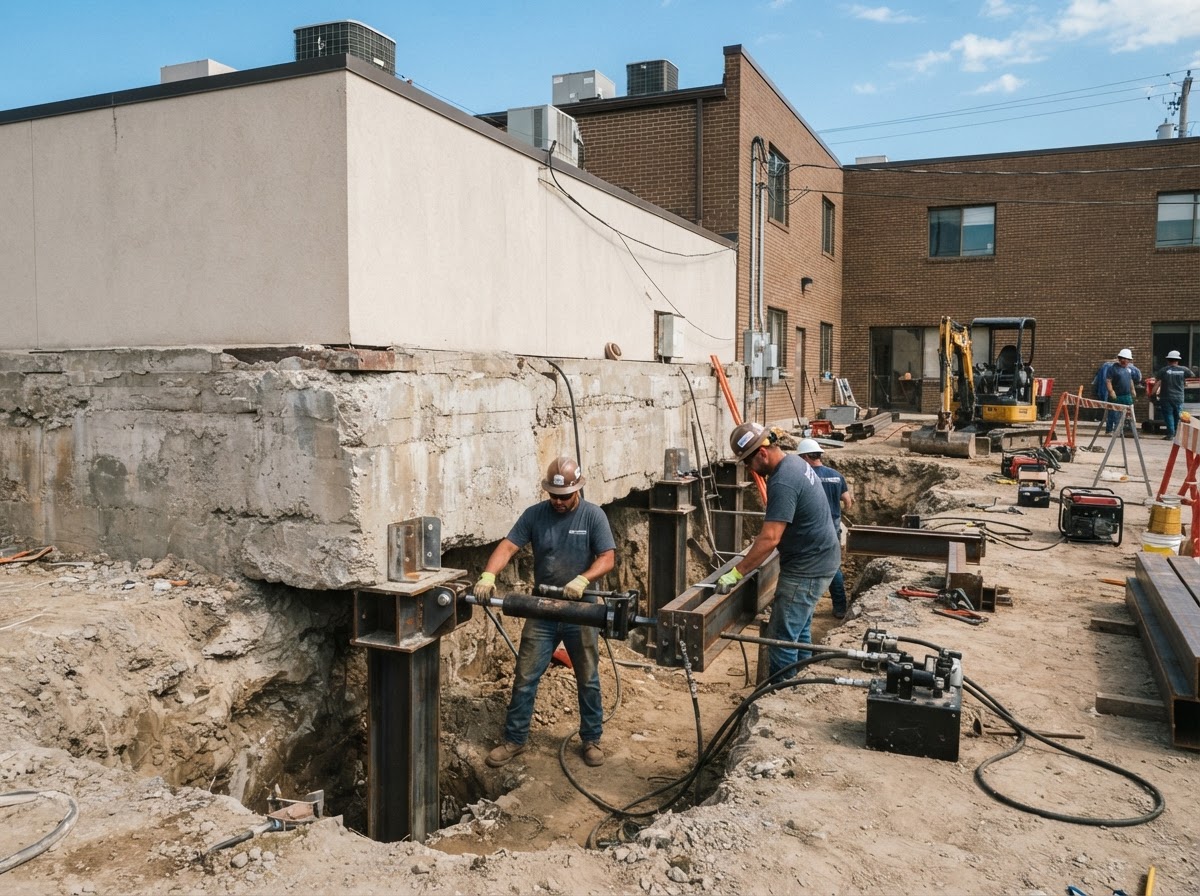
Commercial Foundation Repair & Structural Evaluation in Waldorf
Commercial foundation repair and structural evaluation in Waldorf addresses foundation concerns for commercial and light-commercial properties, including settlement, structural movement, foundation cracks, and support deficiencies. Commercial buildings can have different structural loads and access considerations than residential homes.
A foundation-condition evaluation identifies visible symptoms—cracks, settlement indicators, wall movement, floor elevation concerns—and helps determine appropriate next steps and repair-method priorities. Where additional engineering input is appropriate, that coordination is part of the planning process rather than a substitute for it.
Benefits for Waldorf Property Owners
- Better understanding of visible foundation symptoms
- Identification of areas requiring repair consideration
- More informed repair planning
- Ability to prioritize structural concerns
- Clearer understanding of possible repair approaches
Repair Features & Project Considerations
- Crack patterns and orientation
- Settlement indicators
- Foundation-wall movement
- Floor elevation concerns
- Foundation construction type
- Exterior drainage conditions
Common Repair Types & Solutions
- Foundation-condition evaluation
- Settlement evaluation
- Crack evaluation
- Basement-wall evaluation
- Repair-scope planning
Average Foundation Repair Cost & Pricing in Waldorf, MD
Foundation repair costs in Waldorf vary considerably depending on the type and severity of the structural problem. A foundation crack repair, a sinking foundation repair, and a full multi-wall stabilization project can each sit at very different price points because the work, materials, and access required are not the same. Foundation repair pricing in Waldorf generally depends on the foundation type, crack size and location, settlement severity, the amount of structural movement, the number of piers required, pier depth, soil conditions, access around the home, basement or crawl-space access, wall movement, bowing or leaning walls, floor-joist and beam condition, support-post condition, concrete or masonry deterioration, excavation requirements, and the stabilization method required. Because these conditions differ from property to property throughout Waldorf and Charles County, a reliable foundation repair estimate depends on evaluating the actual structure rather than applying a flat rate.
| Service | Materials, Labor & Major Cost Factors | Typical Waldorf Project Price Range |
|---|---|---|
| Foundation Repair | Foundation type, severity of structural movement, affected area, crack conditions, settlement, wall movement, excavation, access, stabilization method, structural components, labor and whether piers, reinforcement or other repair systems are required. | $1,500–$35,000+ Localized crack or masonry repairs may fall near the lower end, while significant settlement, structural stabilization or multi-system foundation repairs can require substantially larger projects. |
| Foundation Crack Repair | Crack width, length, location, whether the crack is structural or non-structural, accessibility, foundation material, injection or sealing method, wall movement, moisture intrusion and whether additional stabilization is necessary. | $500–$5,000+ Small accessible cracks generally require less work than long, displaced or actively moving structural cracks that require reinforcement or additional foundation repairs. |
| Foundation Settlement & Sinking Foundation Repair | Amount of settlement, affected foundation area, number of stabilization points, pier system, installation depth, excavation, access, structural load, foundation configuration and extent of lifting or stabilization required. | $5,000–$35,000+ Localized settlement may require only several stabilization points, while widespread sinking around multiple portions of a structure can require a larger pier system. |
| Bowing Basement Wall Repair | Amount of wall deflection, wall construction, crack patterns, wall height, accessibility, interior finishes, reinforcement method, anchors, braces, carbon-fiber systems, excavation and drainage conditions where related to the wall movement. | $3,000–$20,000+ Minor wall movement may require a simpler stabilization system, while severely bowed or displaced foundation walls may require more extensive reinforcement. |
| Helical Pier Installation | Number of piers, installation depth, structural load, foundation access, excavation, equipment access, bracket system, soil resistance encountered during installation and whether lifting or stabilization is required. | $6,000–$30,000+ Projects requiring only a few accessible piers generally cost less than structures requiring numerous deep stabilization points or difficult equipment access. |
| Push Pier Installation | Number of push piers, required depth, structural loading, excavation, footing access, brackets, equipment access, affected foundation length and whether the structure requires stabilization only or controlled lifting. | $6,000–$30,000+ The total is primarily influenced by the number of stabilization points and the complexity of accessing and supporting the affected foundation. |
| Foundation Underpinning | Affected foundation length, underpinning method, excavation, structural loads, number of support points, access, footing conditions, temporary support, concrete or steel components and extent of stabilization required. | $8,000–$40,000+ Localized underpinning generally costs less than stabilizing a large portion of a home or addressing settlement affecting multiple foundation walls. |
| Basement Wall Stabilization & Carbon Fiber Reinforcement | Wall length, number of reinforcement strips or supports, crack conditions, wall preparation, wall deflection, surface condition, structural movement, accessibility and whether additional anchors or stabilization systems are necessary. | $2,500–$15,000+ Smaller sections requiring limited reinforcement typically cost less than long basement walls requiring multiple reinforcement points or combined stabilization methods. |
| Crawl Space Structural Repair & Support Jacks | Number of support jacks, beam condition, floor-joist condition, crawl-space height, accessibility, damaged framing, support spacing, footing or base requirements, moisture damage and amount of leveling or reinforcement required. | $2,000–$18,000+ Installing several support points beneath an otherwise sound floor system generally costs less than repairing damaged beams, joists and multiple unsupported areas. |
| Sagging & Uneven Floor Repair | Cause of floor movement, joist condition, beam condition, support-post condition, affected floor area, crawl-space access, structural reinforcement, sistering, support jacks, leveling and underlying foundation movement. | $2,000–$20,000+ Small isolated floor-support problems may require limited reinforcement, while extensive framing deterioration or foundation-related movement can require significantly more structural work. |
| Block & Concrete Foundation Repair | Damaged masonry area, cracked or displaced blocks, concrete deterioration, mortar repairs, wall movement, reinforcement, excavation, accessibility, water exposure and whether structural stabilization is required. | $1,500–$15,000+ Localized masonry repairs generally cost less than rebuilding, reinforcing or stabilizing large sections of a damaged block or concrete foundation. |
| Basement Foundation Waterproofing & Foundation Leak Repair | Extent of water intrusion, number of leaking cracks, wall and floor joint conditions, drainage improvements, waterproofing membrane or coating scope, interior or exterior approach, accessibility, excavation, sump or drainage components and whether related structural stabilization is also required. | $1,500–$20,000+ Sealing a few accessible cracks generally costs less than a full basement waterproofing system that combines exterior drainage, interior drainage and crack repair. |
| Commercial Foundation Repair | Building size, foundation type, structural loads, settlement severity, number of piers or stabilization points, access for larger equipment, occupancy constraints, repair sequencing, excavation, engineering coordination where applicable and extent of structural stabilization required. | $5,000–$50,000+ Minor commercial crack or localized repairs may fall near the lower end, while large-scale structural stabilization of an occupied commercial building can require a substantially larger scope. |
Foundation type, severity of structural movement, affected area, crack conditions, settlement, wall movement, excavation, access, stabilization method, structural components, labor and whether piers, reinforcement or other repair systems are required.
Localized crack or masonry repairs may fall near the lower end, while significant settlement, structural stabilization or multi-system foundation repairs can require substantially larger projects.
Crack width, length, location, whether the crack is structural or non-structural, accessibility, foundation material, injection or sealing method, wall movement, moisture intrusion and whether additional stabilization is necessary.
Small accessible cracks generally require less work than long, displaced or actively moving structural cracks that require reinforcement or additional foundation repairs.
Amount of settlement, affected foundation area, number of stabilization points, pier system, installation depth, excavation, access, structural load, foundation configuration and extent of lifting or stabilization required.
Localized settlement may require only several stabilization points, while widespread sinking around multiple portions of a structure can require a larger pier system.
Amount of wall deflection, wall construction, crack patterns, wall height, accessibility, interior finishes, reinforcement method, anchors, braces, carbon-fiber systems, excavation and drainage conditions where related to the wall movement.
Minor wall movement may require a simpler stabilization system, while severely bowed or displaced foundation walls may require more extensive reinforcement.
Number of piers, installation depth, structural load, foundation access, excavation, equipment access, bracket system, soil resistance encountered during installation and whether lifting or stabilization is required.
Projects requiring only a few accessible piers generally cost less than structures requiring numerous deep stabilization points or difficult equipment access.
Number of push piers, required depth, structural loading, excavation, footing access, brackets, equipment access, affected foundation length and whether the structure requires stabilization only or controlled lifting.
The total is primarily influenced by the number of stabilization points and the complexity of accessing and supporting the affected foundation.
Affected foundation length, underpinning method, excavation, structural loads, number of support points, access, footing conditions, temporary support, concrete or steel components and extent of stabilization required.
Localized underpinning generally costs less than stabilizing a large portion of a home or addressing settlement affecting multiple foundation walls.
Wall length, number of reinforcement strips or supports, crack conditions, wall preparation, wall deflection, surface condition, structural movement, accessibility and whether additional anchors or stabilization systems are necessary.
Smaller sections requiring limited reinforcement typically cost less than long basement walls requiring multiple reinforcement points or combined stabilization methods.
Number of support jacks, beam condition, floor-joist condition, crawl-space height, accessibility, damaged framing, support spacing, footing or base requirements, moisture damage and amount of leveling or reinforcement required.
Installing several support points beneath an otherwise sound floor system generally costs less than repairing damaged beams, joists and multiple unsupported areas.
Cause of floor movement, joist condition, beam condition, support-post condition, affected floor area, crawl-space access, structural reinforcement, sistering, support jacks, leveling and underlying foundation movement.
Small isolated floor-support problems may require limited reinforcement, while extensive framing deterioration or foundation-related movement can require significantly more structural work.
Damaged masonry area, cracked or displaced blocks, concrete deterioration, mortar repairs, wall movement, reinforcement, excavation, accessibility, water exposure and whether structural stabilization is required.
Localized masonry repairs generally cost less than rebuilding, reinforcing or stabilizing large sections of a damaged block or concrete foundation.
Extent of water intrusion, number of leaking cracks, wall and floor joint conditions, drainage improvements, waterproofing membrane or coating scope, interior or exterior approach, accessibility, excavation, sump or drainage components and whether related structural stabilization is also required.
Sealing a few accessible cracks generally costs less than a full basement waterproofing system that combines exterior drainage, interior drainage and crack repair.
Building size, foundation type, structural loads, settlement severity, number of piers or stabilization points, access for larger equipment, occupancy constraints, repair sequencing, excavation, engineering coordination where applicable and extent of structural stabilization required.
Minor commercial crack or localized repairs may fall near the lower end, while large-scale structural stabilization of an occupied commercial building can require a substantially larger scope.
These figures are preliminary planning ranges rather than advertised fixed prices for foundation repair projects in the Waldorf, MD area. Final pricing may be higher or lower depending on measurements, foundation type, structural movement, accessibility, repair method, materials, excavation, engineering or permits where applicable, and the amount of structural stabilization required. Request an on-site foundation evaluation for accurate project pricing.
Request an Accurate Foundation Repair Estimate in Waldorf, MD
Accurate foundation repair pricing requires information about the actual property and structural conditions. Helpful details may include the property address, foundation type, whether the home has a basement or crawl space, visible cracks, bowing walls, uneven floors, doors or windows that have become difficult to operate, areas where settlement is suspected, existing structural repairs, the approximate affected area, and photos of the foundation, basement or crawl space when available. These details help evaluate the property—they do not by themselves confirm foundation failure.
What Causes Foundation Problems in Waldorf?
Foundations rely on the stability of the soil layers directly underneath and surrounding the concrete footings. In Charles County and throughout Southern Maryland, varied seasonal climate cycles and moisture changes constantly alter soil load-bearing capacity.
Cracks are symptoms—not diagnoses. Identifying whether a fracture originates from cosmetic shrinkage, moisture intrusion, soil settlement, or lateral hydrostatic pressure is the critical first step before determining any repair solution.
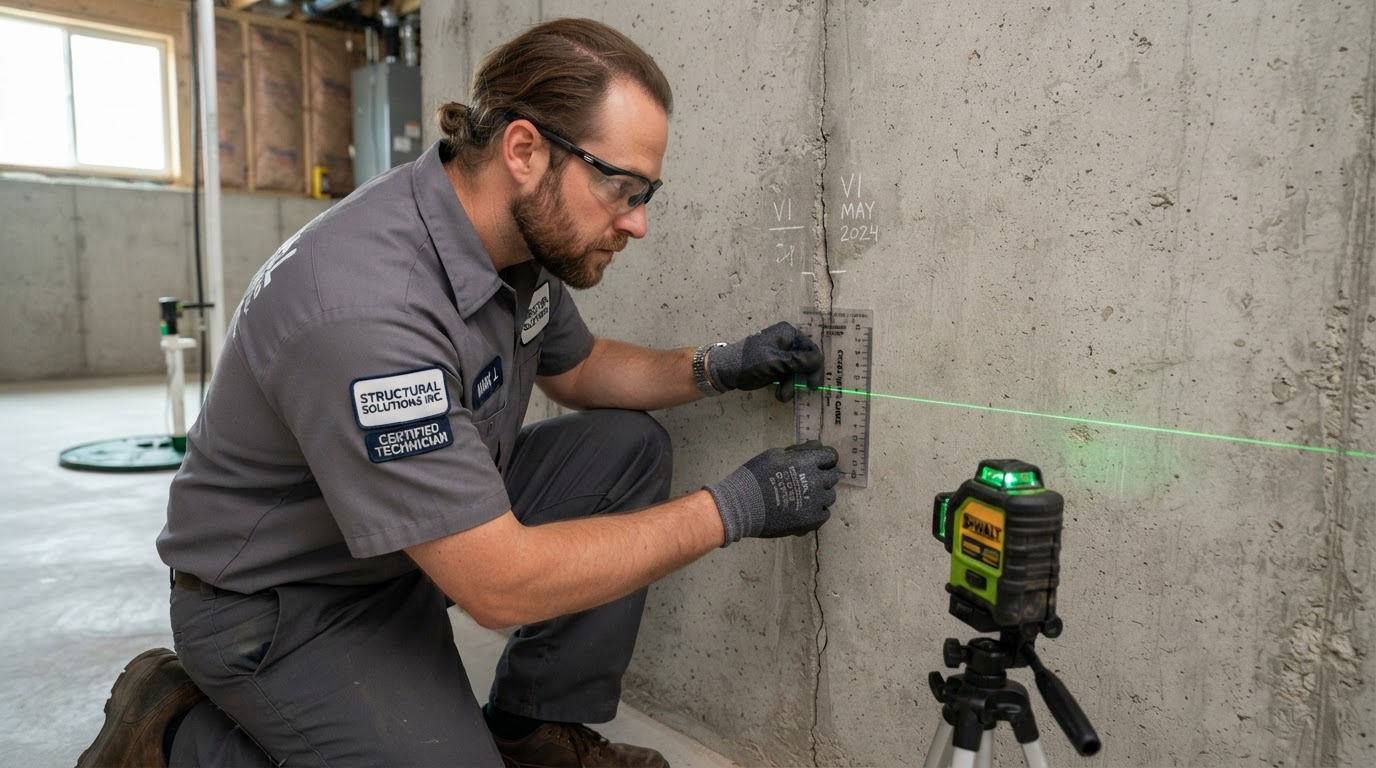
What causes foundation settlement in Waldorf, MD?
Foundation settlement occurs when the soil supporting a home can no longer provide uniform support to the foundation footings. When upper soil strata compress, lose moisture during dry spells, or erode during torrential rains, the footing loses contact with solid bearing ground. As structural weight bears down unevenly, sections of the footing settle downward, causing shearing, sticking doors, and drywall cracks.
How does soil moisture and drainage affect foundation stability?
Moisture imbalances are the single largest contributor to foundation movement. Poor grading, clogged gutters, or misdirected downspouts concentrate rainwater directly against foundation walls. Conversely, prolonged summer drought shrinks moisture-sensitive soils, causing them to pull away from footing perimeters. This continuous cycle of soil expansion and contraction creates localized shifting beneath the structure.
What is hydrostatic pressure and how does it bow basement walls?
Hydrostatic pressure is the lateral force exerted by standing water trapped in the backfill soil surrounding below-grade foundation walls. As saturation levels rise after heavy rain, the trapped water pushes inward with thousands of pounds of pressure. Because concrete masonry block walls have minimal lateral tensile tolerance, this ongoing inward pressure creates horizontal fissures and bows the wall inward toward the basement.
Cosmetic Cracking vs. Potentially Structural Movement
- Hairline vertical shrinkage cracks < 1/16"
- Surface plaster or spalling scaling
- Minor drywall taping separation
- Stable cracks showing no active widening
- Horizontal cracks mid-height on basement walls
- Stair-step cracks along masonry mortar lines
- Inward wall bowing or tilting off plumb
- Visible shear displacement or floor unleveling
Foundation Stabilization Solutions in Waldorf, MD
Addressing foundation distress requires matching structural repair systems to the exact failure mechanism observed. We utilize proven geotechnical methods engineered to secure your home against continuing ground movement.
Helical Pier Underpinning
Helical steel shafts with round plates mechanically torqued down through unstable soils to solid bearing strata, ideal for foundation settlement, additions, and light commercial loads.
Push Pier Systems
Heavy-duty hollow steel tubes driven hydraulically against building reaction weight to competent load-bearing layers, securing heavy masonry and poured concrete foundations.
Carbon Fiber Stabilization
Ultra-high-tensile woven carbon straps applied to interior concrete and masonry block walls with structural epoxy, arresting lateral inward bowing from soil pressure.
Crawl Space Support Jacks
Adjustable heavy-gauge steel support columns installed over reinforced concrete footings to lift and level sagging subfloor girders and stabilize bouncy interior rooms.
Our 6-Step Foundation Repair Process
While engineering specifications vary per property, our diagnostic and repair workflow ensures clear communication and targeted structural execution.
Discuss Visible Problems
We listen to your observations regarding sticking doors, visible cracking, floor movement, or recent water intrusion.
Inspect Affected Areas
A technician conducts an on-site structural inspection evaluating crack widths, wall plumb, floor levels, and exterior grading.
Identify Contributing Conditions
We analyze underlying mechanics—whether differential settlement, hydrostatic push, or crawl space support deficiency.
Determine Repair Approach
We recommend targeted structural systems (piers, wall reinforcement, underpinning) aligned directly with the property's needs.
Complete Stabilization Work
Work is executed using professional equipment, quality structural steel, precision hydraulics, and responsible site protocols.
Review & Maintenance
We walk you through the completed stabilization, answer questions, and provide guidance on moisture management.
A Foundation Repair Approach Focused on the Structure
Rather than relying on aggressive sales tactics or one-size-fits-all repair packages, Waldorf Foundation Repair approaches every property with technical diligence. We build homeowner trust through transparent evaluation, responsible diagnostic language, and solutions that solve structural problems at their source.
Clear Explanation of Visible Conditions
We take the time to walk you through exactly what we see—from crack patterns to wall deflections—explaining what they mean in plain, understandable terms.
Recommendations Based on Property Reality
No two properties share identical soil or structural loads. We tailor repair specifications to your specific foundation rather than pushing proprietary formulas.
Diverse Stabilization Technologies
From helical piers and push piers to carbon fiber wall reinforcement and crawl space jacks, we deploy the specific technology best suited for the mechanical load.
Focus on Causes Over Surface Symptoms
Covering a moving crack with hydraulic cement achieves nothing if the footing is sinking. We focus on halting ongoing movement before cosmetic repairs take place.
“Cracks are symptoms—not diagnoses. Identifying the underlying cause of movement is what protects your structure.”
Surface caulking, patching, or cosmetic plastering may temporarily hide a fissure, but if soil movement, hydrostatic water pressure, or settling footings are active, the stress will continue to distort the building envelope.
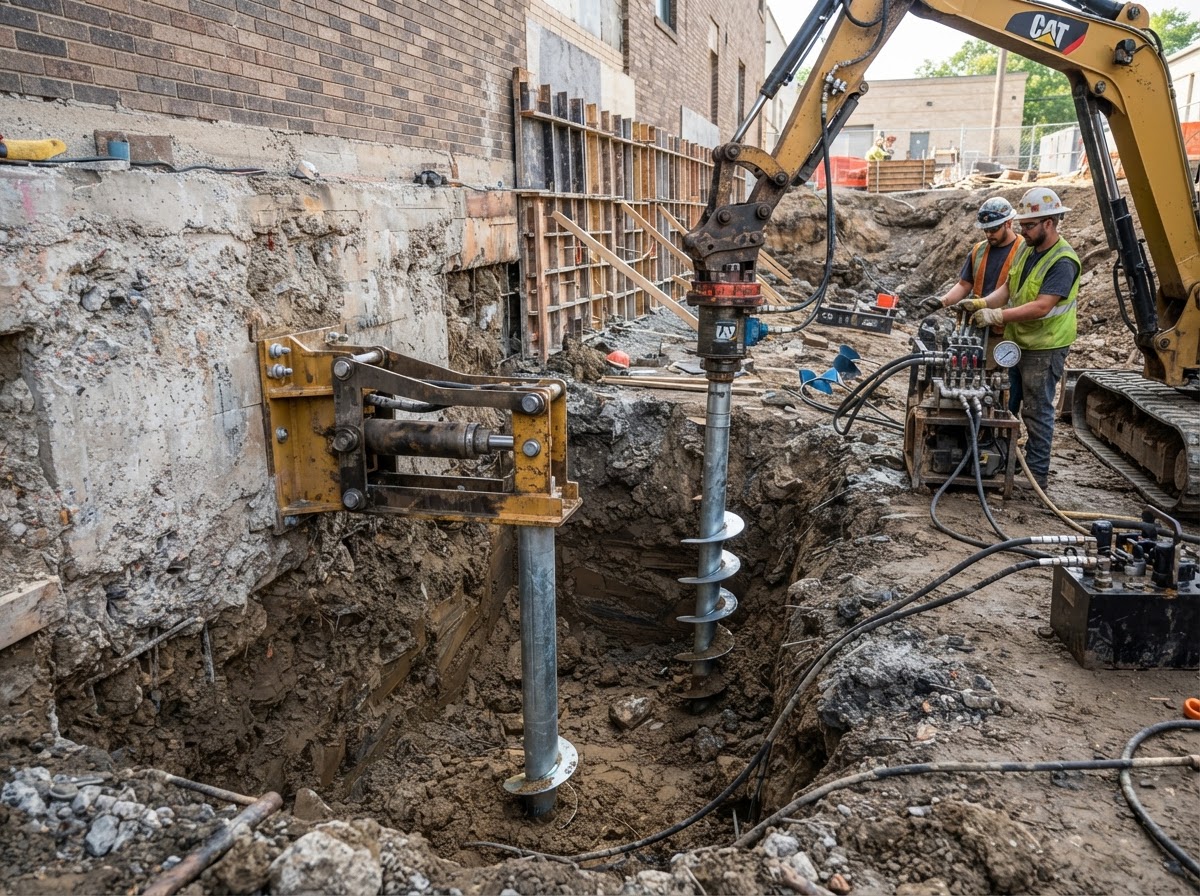
Foundation Repair Near Waldorf and Across Southern Maryland
Waldorf, MD 20601 serves as our central service hub. From our location in Charles County, we provide residential and commercial structural foundation evaluation, crack injection, pier installation, and wall stabilization across neighboring Southern Maryland and Washington, DC metro communities.
Foundation Repair, Pier & Structural Project Gallery in Waldorf, MD
The gallery below illustrates the types of structural foundation problems Waldorf Foundation Repair is equipped to evaluate and repair for homeowners in Waldorf and surrounding Southern Maryland communities. From foundation crack repair and sinking foundation stabilization to bowing basement wall repair, helical and push pier installation, underpinning, carbon fiber reinforcement, crawl space structural repair and sagging floor repair, these images show representative conditions and the professional repair approaches that may apply.
Gallery images are representative service examples intended to illustrate common foundation, basement-wall, pier, crawl-space and structural repair projects. Actual repair methods, materials and project appearance vary based on the structure, soil conditions, foundation type and site conditions.
Foundation Repair Projects in Waldorf, MD
Foundation repair begins with identifying the structural condition and determining why movement or damage is occurring. Appropriate solutions may address cracking, settlement, displaced masonry, structural movement, weakened foundation components or related support problems. No single repair method is appropriate for every property.
Foundation Crack Repair Near Waldorf
Foundation cracks vary significantly in cause and severity. Repair may involve addressing cracks in concrete or masonry while also evaluating whether settlement, water intrusion, lateral pressure or structural movement contributed to the condition.
Foundation Settlement & Sinking Foundation Repair in Waldorf
Foundation settlement may produce symptoms such as wall cracks, separating trim, sticking doors, uneven floors or portions of a structure moving downward. Repair methods depend on the structure, soil conditions, extent of movement and accessibility.
Bowing Basement Wall Repair Near Waldorf
Basement walls can bow, lean or crack when subjected to lateral soil pressure, moisture-related soil changes or other structural forces. Repair methods depend on wall material, displacement, accessibility and the underlying cause.
Helical Pier Installation in Waldorf
Helical piers are deep-foundation elements that may be used in appropriate conditions to transfer structural loads to more suitable bearing soils. Installation requirements depend on structural loads, soil conditions, access and engineering or project specifications where applicable. Helical piers are not required for every settlement problem.
Push Pier Installation Near Waldorf
Push piers may be used for qualifying structures where foundation loads and subsurface conditions make the system appropriate. Installation typically involves accessing the footing, attaching engineered support components and advancing steel pier sections to suitable resistance.
Foundation Underpinning Projects in Waldorf
Underpinning strengthens or extends an existing foundation where additional structural support is required. The exact system depends on the building, existing footing configuration, soil conditions, access and project requirements. Underpinning does not always mean one specific pier type.
Basement Wall Stabilization & Carbon Fiber Reinforcement Near Waldorf
Qualifying basement walls may be reinforced using purpose-designed stabilization systems. Carbon-fiber reinforcement may be appropriate for certain wall conditions, while other situations may require different structural solutions. Carbon fiber cannot correct every bowed or severely displaced basement wall.
Crawl Space Structural Repair & Support Jacks in Waldorf
Crawl-space structural problems may involve weakened beams, undersized or deteriorated supports, settlement or floor-system movement. Appropriate repair may include structural wood repairs, supplemental beams or properly supported adjustable jack systems depending on the condition.
Sagging & Uneven Floor Repair Near Waldorf
Sagging or uneven floors may be related to beam movement, joist damage, inadequate support, crawl-space settlement or other structural conditions. Repairs should address the actual support problem rather than simply covering the visible floor surface.
Discuss Your Foundation Repair Project in Waldorf, MD
Contact Waldorf Foundation Repair to discuss the structural symptoms, foundation conditions and type of repair you may need. Providing photographs and basic property details can help the team better understand the affected area before determining the appropriate next step.
Foundation Repair Questions From Waldorf Property Owners
Find clear, direct answers regarding foundation settlement, wall cracks, pier systems, crawl space supports, and repair expectations for homes in Waldorf and Southern Maryland.
How do I know if my foundation needs repair in Waldorf, MD?
Common warning indicators that a foundation requires professional evaluation include visible stair-step or horizontal cracks along basement walls, persistent sticking around exterior doors and window frames, sloping or bounce in finished interior floors, separation gaps along exterior masonry trim or frieze boards, and outward rotation of concrete chimneys or attached porches. While minor hairline shrinkage cracks can be cosmetic, developing patterns of displacement or widening gaps warrant an on-site structural foundation inspection to assess load transfer.
Are foundation cracks always structural?
No, foundation cracks are not always structural. Minor vertical hairline cracks that measure under one-sixteenth of an inch in poured concrete walls frequently originate from the natural curing and thermal shrinkage of concrete rather than active soil displacement. Conversely, horizontal cracks, stair-step cracks through concrete masonry unit (CMU) mortar joints, or cracks with outward displacement, lateral shear, or water seepage are structural warnings. A systematic on-site evaluation examines crack width, location, direction, and surrounding framing to determine whether structural intervention is appropriate.
What causes a foundation to settle or sink in Waldorf properties?
Foundation settlement occurs primarily when load-bearing sub-surface soil under footings compresses, consolidates, washes out, or loses uniform bearing capacity under the weight of the structure. In Southern Maryland and Charles County, factors such as seasonal moisture fluctuations, variable groundwater tables, concentrated roof runoff from damaged downspouts, drought-induced soil shrinkage, and uneven compaction beneath original footings create differential settlement. When one portion of the foundation settles faster than adjacent sections, stress fractures develop through walls and framing.
Can a sinking foundation be stabilized permanently?
Yes, sinking and settling foundations can be stabilized through engineered underpinning systems such as steel push piers or helical piers. Rather than resting the structure on unstable upper soil layers, piers are mechanically driven or drilled deep into competent, load-bearing strata or bedrock. Once installed to engineering torque or hydraulic load specifications, heavy-duty steel brackets lock onto the foundation footing to transfer building weight, arrest ongoing downward movement, and in appropriate conditions allow for controlled structural lifting.
What is the difference between helical piers and push piers?
The primary technical difference lies in their installation method and mechanical load mechanism. Helical piers feature circular steel screw-plates (helices) welded to a central shaft and are mechanically rotated into the ground using hydraulic drive equipment, making them ideal for light-to-medium structural loads, new construction, porches, and tension applications. Push piers consist of straight high-strength tubular steel sections that are hydraulically driven against the actual weight of the existing building structure until reaching firm bedrock or dense load-bearing strata.
Can bowing basement walls be repaired without complete replacement?
Yes, bowing, tilting, and shearing basement walls can frequently be stabilized and reinforced without the tremendous cost and disruption of complete foundation excavation and replacement. Depending on the extent of inward wall deflection and whether the wall is constructed of poured concrete or concrete block, stabilization solutions include carbon fiber reinforcement grid straps, interior heavy-gauge steel I-beam columns, or helical wall tieback anchors that clamp and restrain the foundation wall against external soil pressure.
When is carbon fiber reinforcement used on foundation walls?
Carbon fiber reinforcement is typically recommended for basement walls experiencing early to moderate inward deflection—generally less than two inches of inward bowing—where the wall has not sustained severe shear dislocation along the base or top course. Carbon fiber straps are bonded directly to the interior masonry surface with structural epoxy, providing immense tensile strength that arrests further inward wall movement from external hydrostatic pressure without consuming usable interior basement square footage.
Can crawl space problems cause sagging floors inside a home?
Yes, crawl space structural failures are among the most common causes of sagging, unlevel, or bouncy interior floors. Within a crawl space, wood rot from elevated relative humidity, wood-boring insects, inadequate spacing of original subfloor support beams, or settling shallow block crawl space piers allow main floor girders to sag under the center load of the home. Installing heavy-duty adjustable steel crawl space support jacks on engineered footings restores solid load-bearing support directly beneath drooping beams.
What causes horizontal cracks in basement walls?
Horizontal cracks in basement walls are almost always caused by lateral earth pressure and hydrostatic pressure pushing against the exterior of the foundation. During periods of heavy precipitation or poor surface drainage, the moisture content in the soil surrounding the foundation expands, exerting immense inward force against the midpoint of the wall. Because concrete block and poured walls possess high compressive strength but limited tensile strength against lateral push, the wall bows inward and develops a horizontal crack line.
Can foundation leaks lead to structural problems if left untreated?
Yes, chronic water intrusion through foundation walls or floor joints can degrade structural components over time. Water entering through foundation cracks accelerates the rusting and corrosion of internal steel rebar, erodes masonry mortar joints, creates hydrostatic pressure buildups, and in crawl spaces promotes fungal wood rot in load-bearing joists and sill plates. While waterproofing handles water management, underlying structural cracking or wall displacement must be properly stabilized alongside moisture control.
How long does foundation repair take on a typical home?
The duration of foundation repair depends entirely on the scope of stabilization required and the specific system being installed. A targeted crack injection or localized carbon fiber strap installation can often be completed in one to two days. More extensive foundation underpinning involving multiple helical or push piers, deep footing bracket excavation, or complete crawl space beam re-support typically requires several days of focused structural work. A thorough initial site evaluation allows our team to outline an accurate project schedule.
Should I have a foundation crack inspected before simply sealing it?
Yes, having a foundation crack evaluated prior to applying surface sealants or caulking is strongly recommended. Surface sealants merely mask visual symptoms and will quickly shear or re-open if the underlying foundation is experiencing ongoing structural settlement or lateral deflection. An inspection identifies whether the crack is active, whether shear displacement has occurred, and whether underlying soil movement must be addressed to ensure permanent stabilization.
Concerned About Your Foundation in Waldorf?
Whether you have noticed fresh stair-step cracks, basement wall movement, sticking doors, uneven floors, or moisture intrusion, discuss your foundation observations with our structural team today.
Waldorf Foundation Repair • Serving Waldorf, MD 20601 • Charles County • Southern Maryland